 The true flame of their Eternal Love The true flame of their Eternal Love
continues to burn brightly after more than 900 years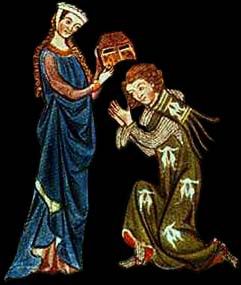
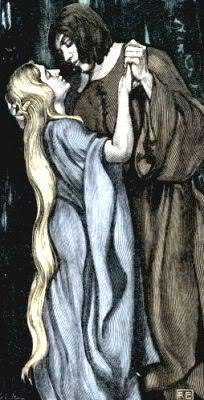
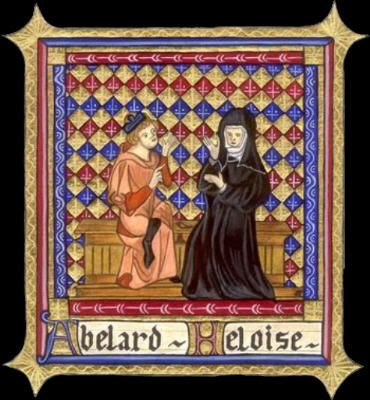
12th Century France. Peter Abelard, was the most famous man of his age. He was a philosopher, teacher, composer and singer. Wherever he went, he was followed by hordes of devoted students and fans. During this period in history, monasteries and the emerging Catholic church were the only employers of educated men. Bound by the church's great pressure upon him not to marry, Abelard had never loved a woman until he met the beautiful and brilliant Heloise, she who was destined to be his own love for eternity.
His beloved Heloise writes of him:
|
What king or philosopher could match your fame? What district, town or village did not long to see you? When you appeared in public, who did not hurry to catch a glimpse of you, or crane his neck and strain his eyes to follow your departure? Every wife, every young girl desired you in absence and was on fire in your presence; queens and great ladies envied me my joys and my bed.
You had besides, I admit, two special gifts whereby to win at once the heart of any woman — your gifts for composing verse and song, in which we know other philosophers have rarely been successful. This was for you no more than a diversion, a recreation from the labors of your philosophic work, but you left many love-songs and verses which won wide popularity for the charm of their words and tunes and kept your name continually on everyone’s lips. The beauty of the airs ensured that even the Unlettered did not forget you; more than anything this made women sigh for love of you. And as most of these songs told of our love, they soon made me widely known and roused the envy of many women against me. For your manhood was adorned by every grace of mind and body. |
 Abelard had seduced his Heloise when he was her tutor, and they were living under the roof of her uncle, Canon Fulbert. They feel deeply in love with each other. Abelard, who could have chosen any woman in the land, recognized in Heloise, his true soul-mate. Abelard describes his beloved, adored Heloise as the highest ideal; the most beautiful, renowned, learned, woman in France. As he describes the early days of their love, their breathless, delirious passion is palpable to us even today: Abelard had seduced his Heloise when he was her tutor, and they were living under the roof of her uncle, Canon Fulbert. They feel deeply in love with each other. Abelard, who could have chosen any woman in the land, recognized in Heloise, his true soul-mate. Abelard describes his beloved, adored Heloise as the highest ideal; the most beautiful, renowned, learned, woman in France. As he describes the early days of their love, their breathless, delirious passion is palpable to us even today:
|
We were united first in the dwelling that sheltered our love, and then in the hearts that burned with it. Under the pretext of study we spent our hours in the happiness of love, and learning held out to us the secret opportunities that our passion craved. Our speech was more of love than of the books which lay open before us; our kisses far outnumbered our reasoned words. Our hands sought less the book than each other's bosoms -love drew our eyes together far more than the lesson drew them to the pages of our text.
— — What followed? No degree in love's progress was left untried by our passion, and if love itself could imagine any wonder as yet unknown, we discovered it. And our inexperience of such delights made us all the more ardent in our pursuit of them, so that our thirst for one another was still unquenched. |
After the uncle found out, and much maneuvering to secure a place in their world, including a flight from the uncle's home to Abelard's estate in Brittany, the birth of their son, Astrolabe, their subsequent secret marriage and return to Paris, where Heloise, finding herself again under the roof of her uncle, denounced the uncle for revealing the marriage to the public. The discordant atmosphere at the uncle's home was untenable for Heloise. Abelard brought her to the convent in Argenteuil where she has been educated, believing his darling wife would be safe there. Fulbert, ostensibly believing Abelard was abandoning Heloise, took revenge on Abelard, by hiring thugs to castrate him. — After this horror, which was known of by all of Paris, they both, Abelard and Heloise, took religious orders, she at his behest, and their son was raised by Abelard's sister, Denise, in Brittany. -In subsequent years they exchanged poignant letters that demonstrated their deep devotion to each other. Heloise writes of her passionate love and desire for Abelard, and Abelard, in his post-castration state, tries to direct Heloise's passion away from him, and toward the all-powerful god of the catholic church. Abelard historian Constant Mews speculated: When he goes into the monastery after the affair, he becomes fascinated by the Holy Spirit. I have to say with such zeal that I’m wondering if there’s not a projection there of the passion for Heloise to the passion for God. So maybe that passion is still there, and it’s just now in a new language, a new framework.
In 2001, a most extraordinary work was published. In The Lost Love Letters of Heloise and Abelard, Constant Mews presents a very convincing case for a newly discovered cache of letters being some of the early correspondence between Heloise and Abelard. A 15th century monk named Johannes de Vepria who was interested in salutations copied what we have of the letters, many just fragments. These fragments give a stunning new perspective to the lovers in the early days of their blinding passion and love for each other.
 
These are the lovers who risked everything for each other; this is the passion that spellbinds us centuries later:
Abelard: You are buried inside my breast for eternity, from which tomb you will never emerge as long as I live. There you lie, there you rest. You keep me company right until I fall asleep; while I sleep you never leave me, and after I wake I see you, as soon as I open my eyes, even before the light of day itself. To others I address my words, to you my intention.
Heloise: Surely I have discovered in you, since I love you, undoubtedly the greatest and most outstanding good of all. Since it is established that this is eternal, it is for me the proof beyond doubt that you will remain in my love for eternity. Therefore believe me, desirable one, that neither wealth, distinctions, nor all the things that devotees of this world lust after, will be able to sever me from love for you. Truly there will never be a day in which I would be able to think of myself and let it pass without thinking of you. Know that I am not concerned by any doubt that I may hope the same thing from you.
Abelard: I will always love you, I will always carry you in my spirit. Nor should you be surprised that twisted jealousy should turn its eyes towards such a conspicuous and fitting friendship as ours, because if we were miserable, we could undoubtedly live among others however we liked without any malicious attention. Therefore, let them backbite, let them drag us down, let them gnaw, let them waste away inside, let them derive their bitterness from our good things. You will still be my life, my breath, my restoration in difficulty, and finally, my complete joy. Farewell, you who make me fare well.
Heloise: To her love most pure, worthy of any fidelity, through the state of true love the secret of tender faith. May the ruler of heaven mediate between us; may he accompany our faith. Farewell, and may Christ King of Kings save you my sweetest for eternity. Farewell in him who governs all things in the world.
Abelard: To his brightest star, whose rays I have recently enjoyed. May she shine with such unfailing splendor that no cloud can obscure her. Because you, my sweetest lady, have so instructed me, or to speak more truly, because the burning flame of love compels me, your beloved could not restrain himself from greeting you as he can through the agency of a letter in place of his actual presence. Therefore keep well, just as I need your keeping your well; and farewell, just as my faring well depends on your doing so. In you is my hope; in you my rest. Never do I wake so suddenly that my spirit does not find you present within itself.
Heloise: To my joyful hope, my faith and my very self with all my devotion as long as I live. May he bestower of every art and the most bountiful giver of human talent, fill the depths of my breast with the skin of the art of philosophy in order that I may greet you in writing, most beloved, in accord with my will. Farewell. Farewell, hope of my youth.
Abelard: You often ask me, my sweet soul, what love is - and I cannot excuse myself on grounds of ignorance, as if I had been asked about a subject unfamiliar to me. For that very love has brought me under its own command in such a way that it seems not to be external but very familiar and personal, even visceral.
Heloise: If a droplet of no ability trickled down to me from the honeycomb of wisdom, I would try with every effort of my mind to portray in the jottings of my letter, various things with a fragrant nectar of your nourishing love. But throughout all eternity no phrase has yet been found that speaks clearly about how intent on you is my spirit. For God is my witness that I love you with a sublime and exceptional love. And so there is not, nor ever will be, any event or circumstance except death, that will separate me from your love. For this reason, every day there is in me the desire and wish that I may be restored by your soothing presence, and one day will seem a month to me and a week a year, until that sweetest vision of your love appears. So much pain sprouts and thrives in my heart that not even a whole year would suffice for its description. My body too is sad. My spirit transformed from its usual cheerfulness. Farewell. |
 Over the centuries, critics sometimes proclaim that Abelard's love for Heloise was returned in less measure than he received from her. They who criticize do not understand the times or the predicament Abelard was in. Not only did they live in a time when the catholic church ruled everything, and the only course for a philosopher and teacher like Abelard was to live his life was within it's constraints; after he was attacked, he was destroyed, -a broken man in spirit and body; if it seemed in the later letters that he ever tried to refute their love, it was because Heloise's physical and emotional desire burned as brightly as ever for Abelard, and in the state he was in after he was castrated, any semblance of normal relations between a husband and wife, was an impossibility. In instructing Heloise to turn her love and passion for him into passion for the god of the catholic church and her duties as Abbess, he saw it as the best way to bring peace of mind to his beloved girl, who had, along with him, been thrust into this impossible, tragic situation. -He not only gave the Oratory of the Paraclete to Heloise and her Sisters, his response to Heloise's entreaties for theological and practical instruction from him were replied to with all he had to give her; the treatises and hymns written for the Paraclete on Heloise's behalf, which were the tribute to and comfort from a loving husband trying to do the best he could for his beloved wife, irrevocably lost to him. Over the centuries, critics sometimes proclaim that Abelard's love for Heloise was returned in less measure than he received from her. They who criticize do not understand the times or the predicament Abelard was in. Not only did they live in a time when the catholic church ruled everything, and the only course for a philosopher and teacher like Abelard was to live his life was within it's constraints; after he was attacked, he was destroyed, -a broken man in spirit and body; if it seemed in the later letters that he ever tried to refute their love, it was because Heloise's physical and emotional desire burned as brightly as ever for Abelard, and in the state he was in after he was castrated, any semblance of normal relations between a husband and wife, was an impossibility. In instructing Heloise to turn her love and passion for him into passion for the god of the catholic church and her duties as Abbess, he saw it as the best way to bring peace of mind to his beloved girl, who had, along with him, been thrust into this impossible, tragic situation. -He not only gave the Oratory of the Paraclete to Heloise and her Sisters, his response to Heloise's entreaties for theological and practical instruction from him were replied to with all he had to give her; the treatises and hymns written for the Paraclete on Heloise's behalf, which were the tribute to and comfort from a loving husband trying to do the best he could for his beloved wife, irrevocably lost to him.
To Abelard's critics: The pure, shining, faithful, glorious love of Heloise for her Abelard wasn't evoked in her from nothing; it wasn't evoked undeserved by Abelard.
This is certain, and must be clear: Abelard adored his Heloise above all else.
-This truncated account and a few quotations from these true lovers serves the purpose of conveying the message of this Clue in The Conundrum, but it does not well serve Abelard and his Heloise, for their story, one of Love that transcends all space and time, is one of the great love stories the world has seen. The links below provide a better picture of their story:
|